
Why Ghana Must Choose Strategic Negotiation Over Emotional Retaliation
Recent calls by some public commentators, civil society leaders, politicians, and policy advocates for the Government of Ghana to refuse renewal of Gold Fields’ Tarkwa Mine lease have sparked an important national conversation. The concerns driving these calls, particularly the reports of xenophobic attacks against foreign nationals, including Ghanaians, in South Africa, are understandable. Every Ghanaian should condemn such attacks in the strongest possible terms. No individual should be targeted because of nationality, race, ethnicity, or origin.
However, while public anger may be justified, the decisions of governments concerning investment, mining leases, and economic development cannot be driven by emotions. They must be based on facts, evidence, national interest, and long-term economic strategy.
The issue before Ghana is therefore not whether xenophobia is wrong—it unquestionably is. The real question is whether refusing to renew Gold Fields’ lease at Tarkwa would serve Ghana’s economic interests and development objectives. The evidence suggests that it would not.
Business Decisions Must Be Grounded in Facts
Throughout the world, governments routinely separate diplomatic disagreements from investment decisions. Countries that attract sustainable investment do so because investors have confidence that contracts, licences, and leases will be administered based on law, policy, and commercial realities rather than political sentiments.
If Ghana were to deny lease renewal solely because a company originates from a country where some citizens have engaged in unacceptable conduct, it would send troubling signals to the international investment community. Investors seek jurisdictions where regulatory decisions are predictable, transparent, and based on objective criteria.
Ghana has built a strong reputation over decades as one of Africa’s most stable and investor-friendly mining destinations. That reputation should not be jeopardized by actions that may be perceived as punitive rather than commercially justified.
Gold Fields Has Made Significant Long-Term Investments
Any objective assessment of Gold Fields’ operations at Tarkwa must acknowledge the substantial investments the company has made over the years.
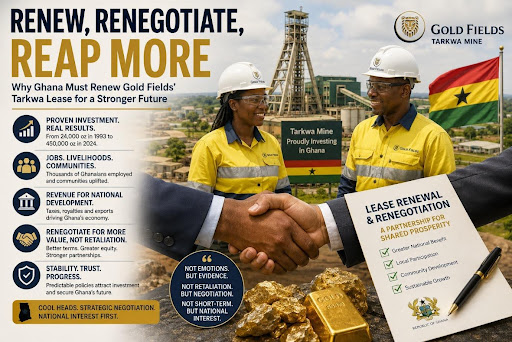
When Gold Fields assumed responsibility for the mine in the early 1990s, annual production was approximately 24,000 ounces of gold. Through sustained investment in exploration, mine development, technology, infrastructure, environmental management, and human capital, production has increased dramatically to approximately 450,000 ounces annually.
Such growth does not occur by accident.
It reflects billions of dollars in cumulative investment, decades of technical expertise, continuous reinvestment, and a willingness to take long-term operational risks. The mine’s current productivity is the result of years of capital expenditure and strategic planning.
Those advocating the non-renewal of the lease must answer an important question: would the Tarkwa Mine be at its current scale, efficiency, and production level without these investments?
The answer is likely no.
Ghana Has Benefited Significantly
Beyond gold production, Gold Fields has contributed substantially to Ghana’s economy through taxes, royalties, employment, procurement, infrastructure development, community investments, and foreign exchange earnings.
Thousands of Ghanaians are directly and indirectly employed through the company’s operations. Local contractors, suppliers, transporters, service providers, and communities depend on the economic activity generated by the mine.
The mining sector remains one of Ghana’s largest sources of export revenue and foreign exchange. In an environment where the country continues to face fiscal pressures, balance-of-payment challenges, and a need for investment capital, decisions affecting major mining operations must be approached with extreme caution.
The closure, disruption, or uncertainty surrounding a major operation such as Tarkwa could have consequences extending far beyond the mining sector.
Lease Renewal Does Not Mean Accepting the Status Quo
Supporting lease renewal should not be confused with accepting the existing arrangements without question.
Indeed, the upcoming lease renewal presents an important opportunity for Ghana to negotiate a better deal.
The government has every right—and indeed a responsibility—to pursue terms that maximize national benefits. This could include:
- Increased state participation where commercially viable.
- Enhanced opportunities for Ghanaian private investors.
- Stronger local content commitments.
- Expanded employment and skills development programmes.
- Greater support for local suppliers and contractors.
- Increased investment in host communities.
- Improved environmental and mine closure provisions.
- Stronger commitments to value addition and downstream processing.
The objective should be to secure a larger share of the benefits while maintaining investor confidence.
This is how mature resource-rich countries approach negotiations. They seek better terms through dialogue and commercial engagement, not through actions that undermine investment certainty.
National Interest Requires Strategic Thinking
Natural resource governance is most effective when decisions are guided by long-term national interests rather than short-term political pressures.
A refusal to renew the lease without compelling operational, legal, environmental, or economic reasons could expose Ghana to unnecessary risks. It could trigger investor concerns, affect future mining investments, and create uncertainty about the country’s commitment to predictable business rules.
Conversely, a well-negotiated renewal could achieve multiple objectives simultaneously:
- Protect jobs.
- Sustain production.
- Maintain export earnings.
- Increase Ghanaian participation.
- Improve government revenues.
- Preserve Ghana’s investment reputation.
Such an outcome would represent a win-win solution for both Ghana and investors.
The Xenophobia Issue Must Be Addressed Through Appropriate Channels
The xenophobic attacks against Ghanaians and other foreign nationals in South Africa deserve strong condemnation and firm diplomatic engagement.
The Government of Ghana should continue to engage South African authorities through diplomatic channels, regional institutions, and bilateral mechanisms to ensure the protection of Ghanaians living and working abroad.
However, it would be a mistake to conflate the actions of criminal elements or extremist groups with the operations of a company that has invested in Ghana for decades and complied with the country’s regulatory framework.
The appropriate response to xenophobia is diplomacy, law enforcement, and international cooperation—not economic retaliation against a company whose operations have contributed significantly to Ghana’s development.
A Time for Calm and Responsible Leadership
Public debate is healthy and necessary in any democracy. Citizens have every right to demand greater benefits from Ghana’s natural resources and greater accountability from mining companies.
Yet leadership requires balancing public sentiment with economic reality.
The challenge before government is not whether Gold Fields should continue operating under exactly the same terms. The challenge is how Ghana can leverage the lease renewal process to secure greater national benefits while maintaining the confidence of investors and preserving economic stability.
Cool heads must therefore prevail.
The Government of Ghana should approach the renewal of Gold Fields’ Tarkwa lease with firmness, strategic vision, and a commitment to maximizing national value. It should negotiate hard, insist on improved terms where justified, and ensure that Ghana receives a fair share of the benefits generated by its mineral resources.
What it should not do is allow emotion to substitute for sound economic judgment.
In matters of national development, wisdom lies not in retaliation, but in negotiation; not in symbolism, but in securing outcomes that advance the long-term interests of the Ghanaian people.