
Across Ghana today, a growing chorus of voices is calling for greater national control over the country’s natural resources. Think tanks such as the Institute of Economic Affairs (IEA), policy commentators, civil society organisations and sections of the public have questioned whether Ghana is receiving a fair share of the benefits from its mineral wealth.
Some have argued that government should not renew the Gold Fields Tarkwa lease when it expires in 2027. Others have called for Ghanaians to take control of the “commanding heights” of the mining sector. Still others have advocated various forms of resource nationalism, insisting that Ghana must own and directly operate a larger share of its mineral assets.
These arguments are not without merit. After more than a century of mining, it is understandable that many citizens are asking difficult questions. Why do mining communities remain underdeveloped despite enormous mineral wealth? Why does Ghana continue to export raw resources while importing finished products? Why are local participation and ownership still limited in key sectors of the economy?
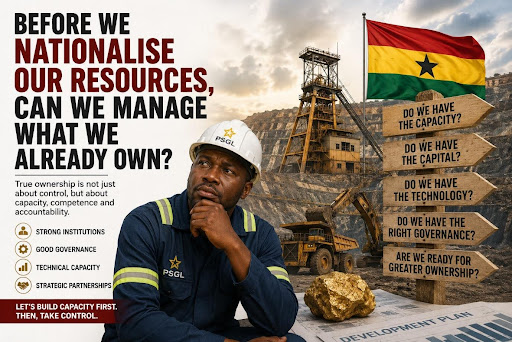
These are legitimate concerns that deserve serious national discussion. However, before we rush toward resource nationalisation, there is an equally important question we must ask ourselves: Have we demonstrated the capacity to effectively manage the mining assets we already own? This question may be uncomfortable, but it is necessary.
The recent announcement that state-owned Prestea Sankofa Gold Limited (PSGL) has secured a strategic partnership with China’s Guangzhou Hozdo Group provides an opportunity for reflection.
PSGL is not a private foreign-owned company. It is a state-owned mining enterprise under the Ghana National Petroleum Corporation (GNPC). Yet despite operating in one of the world’s most attractive gold jurisdictions, the company has struggled with operational challenges, aging equipment, financial constraints, production setbacks and infrastructure deficiencies.
According to recent reports, the company has gone months without production and now requires external financial, technical and equipment support to revive operations and position itself for future growth. Yet we have the men to run the mining industry.
There is no shame in seeking strategic partnerships. In fact, partnerships are often necessary for growth and sustainability. The more important question is this: If we are struggling to successfully operate and expand a state-owned mine today, what gives us confidence that we can suddenly manage a much larger portfolio of nationalised mining assets tomorrow?
This is not an argument against Ghanaian ownership. It is an argument for realism. History offers valuable lessons.
In the 1980s and early 1990s, Ghana owned and controlled a significant number of state enterprises across mining, manufacturing, transportation, agriculture, banking and other sectors. Many of these enterprises were established with noble intentions to promote national development, create jobs and ensure local control of strategic assets.
Unfortunately, many eventually collapsed under the weight of political interference, weak governance structures, inefficiency, inadequate capitalisation and poor management practices.
The result was a wave of divestitures, restructurings and privatisations. The lesson is not that state ownership is inherently bad. Nor is the lesson that foreign investment is inherently good. The lesson is that ownership alone does not create value.
Competence does. Governance does. Accountability does. Technology does. Capital does. And management does.
Countries that have successfully leveraged their natural resources have not merely focused on ownership. They have focused on building institutions.
Norway’s success in petroleum did not begin with nationalisation. It began with institution-building, regulatory excellence, technical capacity development and long-term strategic planning.
Botswana’s success in diamonds was not simply about ownership. It was about disciplined governance, prudent management and strong partnerships that gradually increased national participation.
Even Saudi Arabia’s success with Aramco was built on decades of technical capacity transfer, knowledge acquisition and institutional development.
In every successful case, capacity preceded control. Which Ghana is already working. Ghana must learn from these examples. Rather than reducing the national conversation to whether a lease should or should not be renewed, we should be asking broader questions.
Do we have access to the billions of dollars required for mine development, expansion and exploration? Do we have governance structures strong enough to insulate state-owned enterprises from political cycles? Do we have the technology to operate the various ore bodies in Ghana? Can Ghanaians alone mine all the gold reserve in Ghana? Do we have the managerial discipline necessary to compete in a highly sophisticated global mining industry? Do we have a clear national blueprint for increasing Ghanaian ownership and participation over the next twenty years?
Unfortunately, the answer to many of these questions remains uncertain. This is where the conversation needs to evolve. Instead of focusing exclusively on nationalisation, Ghana should focus on creating a comprehensive national resource ownership strategy.
Such a strategy should include Building Strong State-Owned Enterprises. Prestea Sankofa Gold Limited should become a national laboratory for excellence in mining management. Its success or failure will provide valuable lessons for future state participation in the sector.
Expanding Ghanaian Equity Participation: Government should explore mechanisms that allow pension funds, insurance companies, mutual funds and ordinary citizens to acquire stakes in mining assets through transparent public investment structures.
Strengthening Local Content: The real economic benefits of mining often extend beyond ownership of the mine itself. Ghanaian companies should build factories in Ghana to meet the mining input demand and not just import products or fronting for foreigners as has been the case mostly.
Continue Developing Technical Capacity: Universities, technical institutions and mining companies should collaborate to produce world-class mining engineers, geologists, metallurgists, environmental scientists and mining executives.
Establishing a Sovereign Resource Investment Framework: Rather than focusing solely on ownership of individual mines, Ghana should strategically invest mining revenues into productive sectors that generate long-term economic diversification.
Improving Governance: State participation without strong governance will only create new problems. Transparency, accountability and professional management must be non-negotiable.
The ultimate goal should not be nationalisation for its own sake. The goal should be national prosperity. If greater state ownership contributes to prosperity, then it should be pursued. If strategic partnerships deliver better outcomes, they should also be considered. If hybrid ownership structures provide the optimal balance, they should not be dismissed.
What matters is not ideology. What matters is results. Ghana’s mineral resources belong to the people of Ghana. That principle is already established under our Constitution. The challenge before us is not simply who owns the resources on paper. The challenge is who can create the greatest value from those resources for current and future generations.
Before we demand control of larger assets, we must demonstrate excellence in managing the assets already under our control. Before we seek to take over the commanding heights of the economy, we must build the institutions capable of governing those heights effectively. And before we embrace resource nationalism as a solution, we must first develop a credible blueprint for success.
Otherwise, we risk replacing one set of frustrations with another. The debate Ghana needs is therefore not simply about ownership. It is about capacity. It is about governance. It is about technology. It is about strategy. And ultimately, it is about whether we are prepared to transform our natural resource wealth into lasting national prosperity. That is the conversation worth having.